Telar
An open-source framework for building interactive visual narratives from digitized objects
Summary
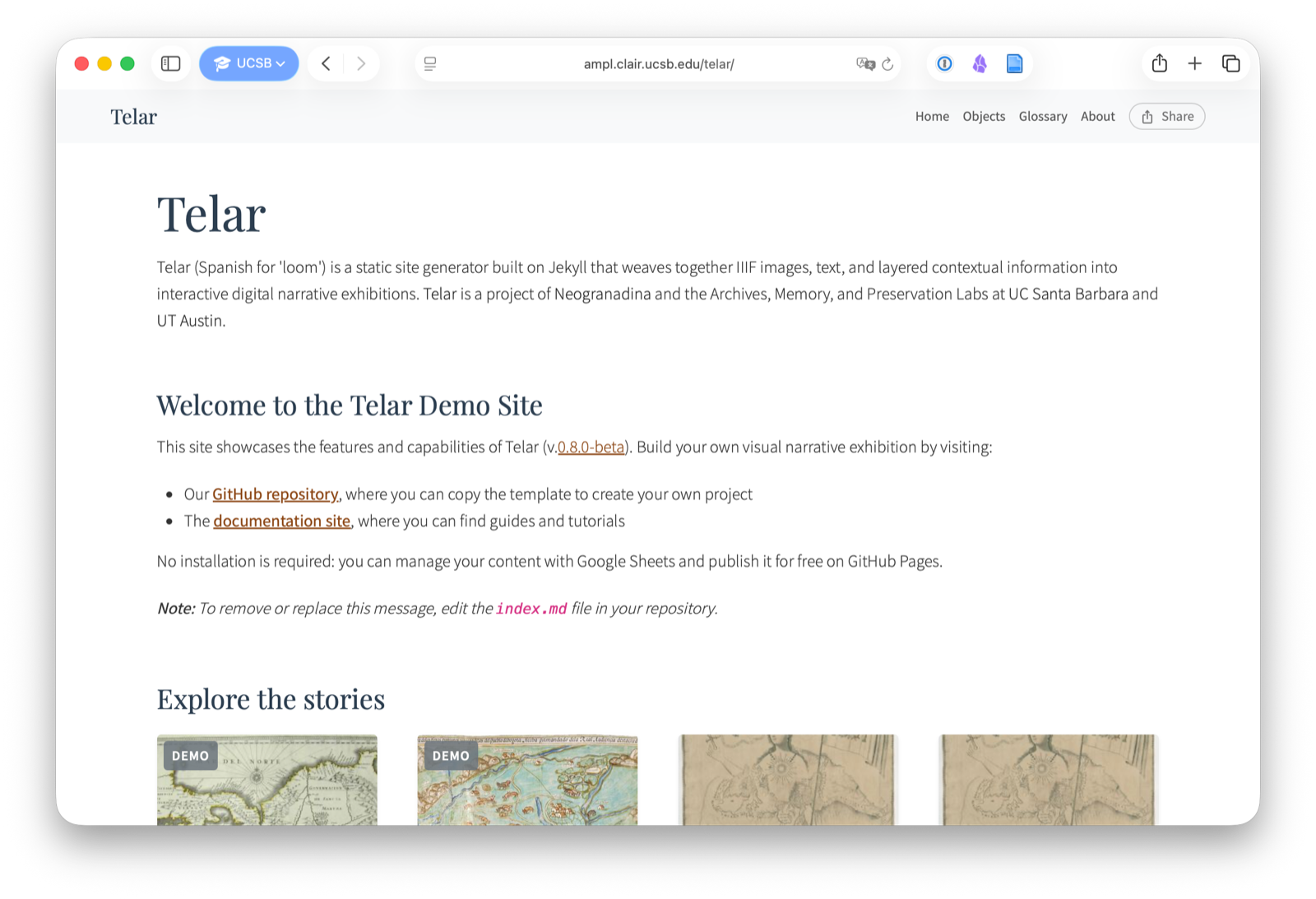
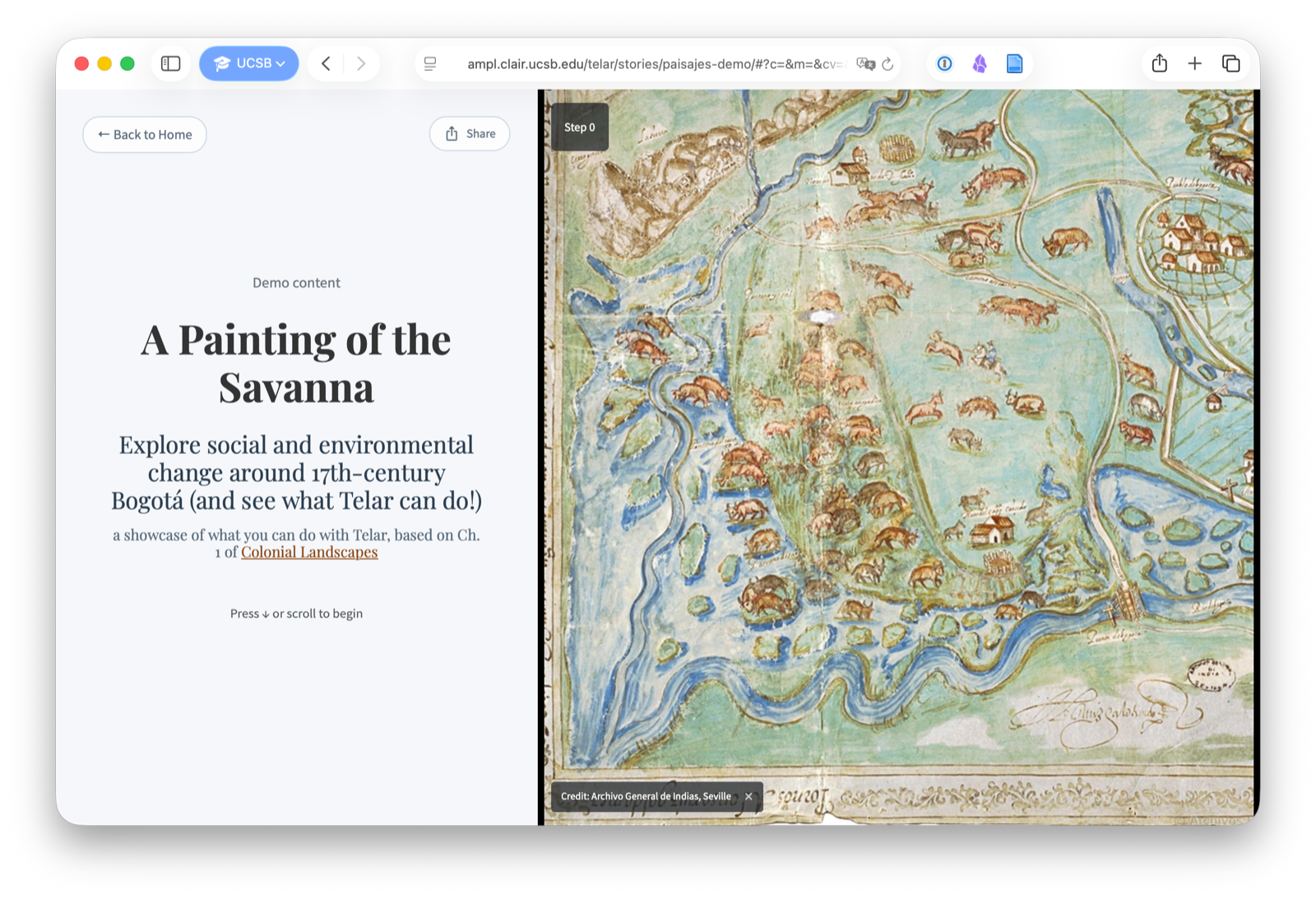
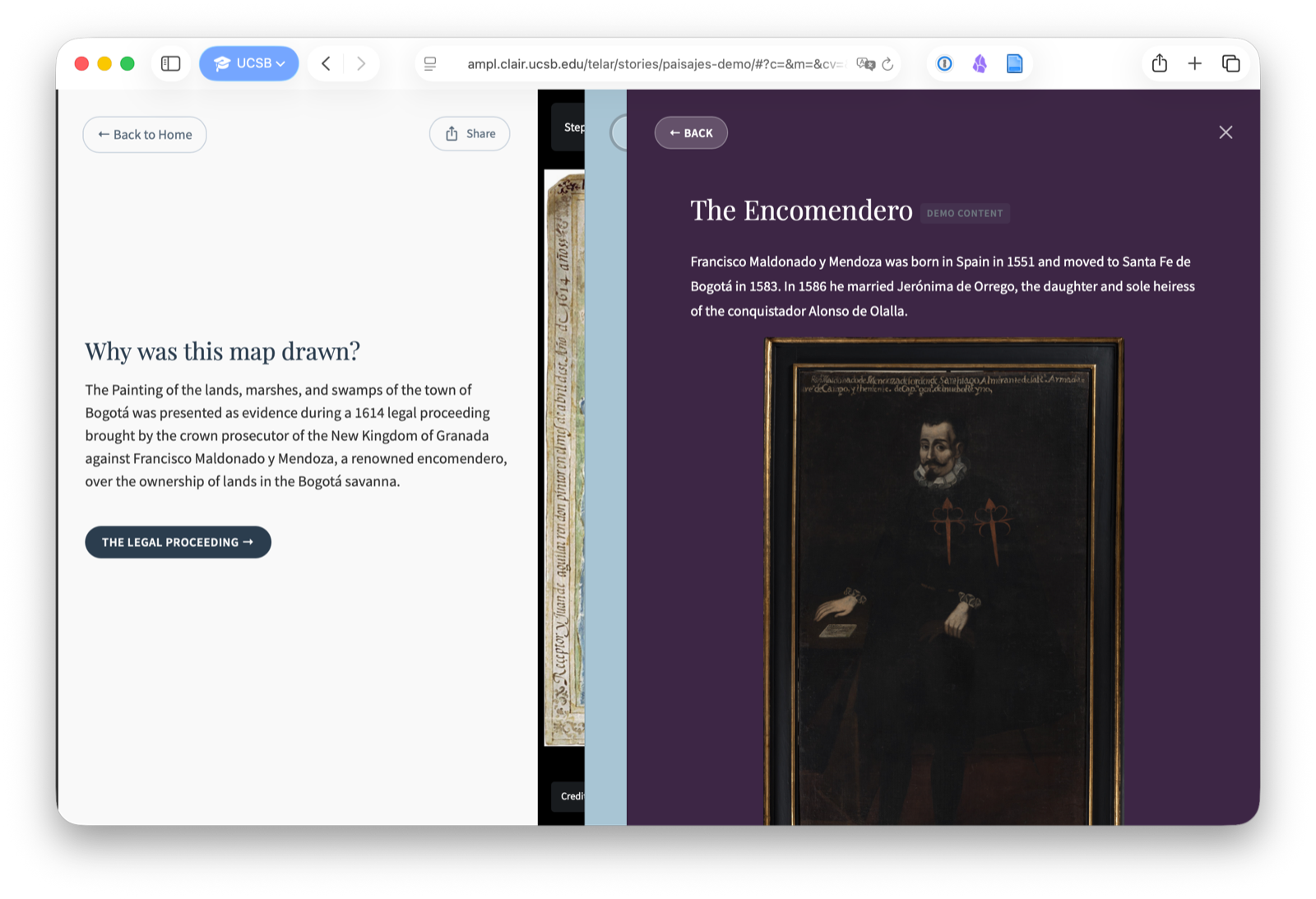
Telar — Spanish for loom — is an open-source framework for weaving IIIF images, audio, video, and texts into layered visual narratives around digitized objects: maps, manuscripts, photographs, sound recordings. It runs on minimal-computing principles: authoring happens in plain text, the site is generated statically, and it is hosted for free on GitHub Pages, so a project can stay online for years with very little maintenance. Telar grew out of Colonial Landscapes, our 2020 platform on the Bogotá region seen through a 1614 map, and generalizes that approach into a reusable framework. The code is on GitHub.
How it works
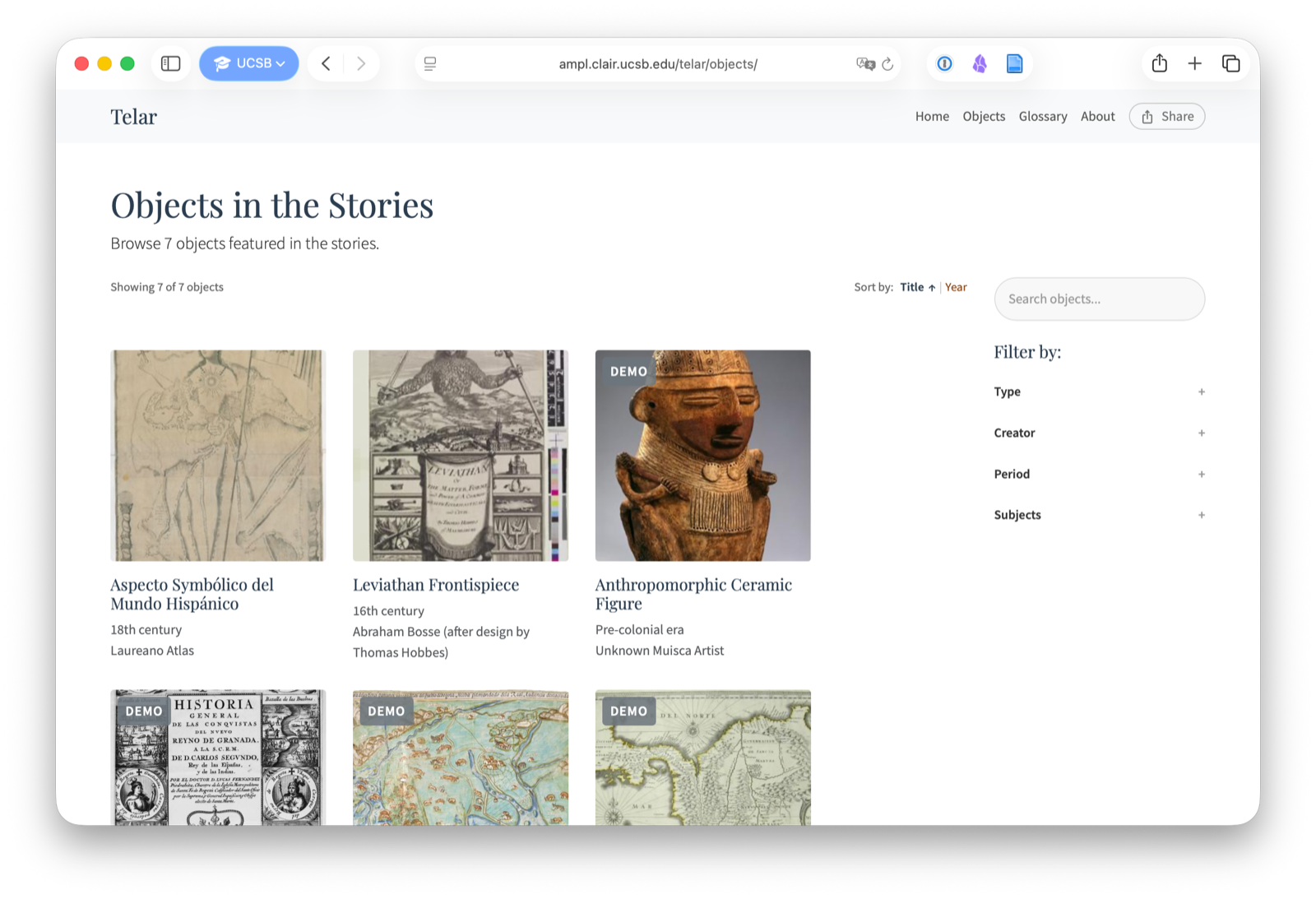
A Telar story is a sequence of steps: each pairs a view of an image with a brief observation, and the image pans and zooms as the reader moves through it. Around that thread you can add layers —context panels, glossaries, transcriptions— without cluttering the narrative. Alongside the stories, Telar generates object galleries with search and filters, so audiences can follow a guided narrative or explore the collection on their own; for smaller collections it works as a complete publication system, and for larger ones there is Zasqua. Its real value is in composition: building a narrative forces decisions about what to show, what to leave out, and in what order, which is why in the classroom students produce knowledge rather than only consuming it.
Features
- Bilingual interfaces in English and Spanish
- Authoring through the Telar Compositor or from spreadsheets
- Your own images, or images served via IIIF from public collections
- Client-side encrypted stories for sensitive material, and Canvas embedding
Links
Partners
Telar is developed at the Archives, Memory, and Preservation Lab (AMPL) at the University of California, Santa Barbara, in collaboration with Neogranadina and the University of Texas at Austin. It has been supported by the Caribbean Digital Scholarship Collective, the Department of History at the University of Texas at Austin, CITRAL, the Burdick Global Scholars Program, and the UCSB Library.